
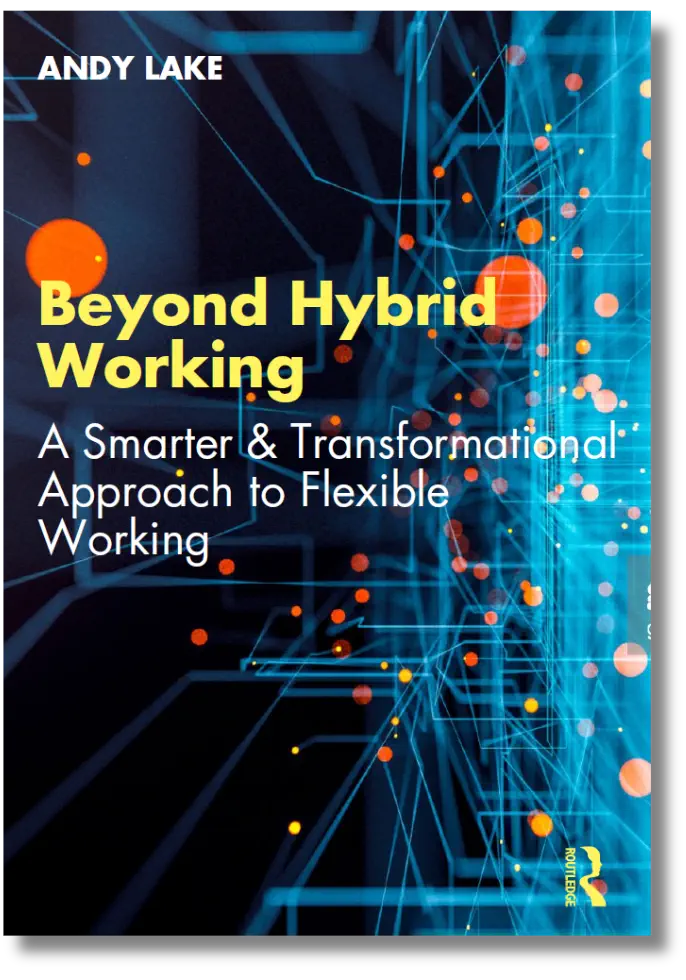

Beyond Hybrid Working – A Smarter & Transformational approach to Flexible Working
£27.50
Beyond Hybrid Working is a book that does exactly what it says on the tin. It’s an engaging and practical book that maps out a way move forward from the uneasy compromises of “hybrid working” by adopting a transformational approach to new and more flexible ways of working.
Available for UK delivery only
Description
Beyond Hybrid Working is a book that does exactly what it says on the tin. It’s an engaging and practical book that maps out a way move forward from the uneasy compromises of “hybrid working” by adopting a transformational approach to new and more flexible ways of working.
At the heart of the book is an approach that relentlessly focuses on the “why?” of modernising working practices, with the aim of helping organisations to identify and achieve targeted benefits – for the business, for employees, for the environment and for wider society.
The book’s comprehensive scope takes in the key areas for change – working practices, processes, the physical workplaces, technology (including the impact of AI), culture and leadership. These are combined into an integrated and strategic approach.
Beyond Hybrid Working is a must-read resource for leaders in the areas of Workplace, Technology and People, and anyone entrusted with modernising ways of working in the post-pandemic era.
What’s in the book?
Chapter 1 provides a definition of Smart Working, and attempts to clarify where it differs from other conceptions of work flexibility. The Glossary further supports this quest for clarity, and how different terms are used throughout the book.
Chapter 2 provides an overview of ten trends that provide a following wind for the changes we see in the world of work. These provide the context for the comprehensive approach to the transformation that distinguishes Smart Working.
Chapters 3 and 4 cover developing the strategy, the principles, business case and metrics that set the foundations for an integrated and comprehensive programme of change. Improvisation and tactical now need to be replaced by a comprehensive and strategic approach. These chapters set out the parameters of a programme, areas of investment and saving, how to get the baseline insights for change and develop metrics for monitoring progress and evaluation.
Chapters 5 to 10 cover the core functional areas of People, Property and Technology that have to work together in a strategic programme. Chapter 5 focuses on the ways people work and how to engage everyone in working smarter. The transformations set out in the following chapters hinge on people understanding the relationships between tasks, place, time, flexibility and the potential for change.
Chapters 6 to 8 (and also 12) cover the various locations of the workplace. Chapter 6 looks at the organisation-owned workplace where employees have traditionally gathered with their managers. Chapter 7 addresses the wider Extended Workplace, a core concept of this book, and the need to establish equality between work locations. This section also covers the fast-growing area of coworking. Chapter 8 addresses the Virtual Workplace, which is where we also work, whatever physical location we are in, and technologies coming over the horizon that are likely to impact the ways we work.
Chapters 9 and 10 focus on people and culture – how to develop a culture of Smart Working, and how to manage Smart Working teams. This involves trying to steer thinking away from the assumption found in most other guides that there is a central, most important place for work and where the manager normally is, and there are difficulties to overcome caused by teams being dispersed and ‘remote’.
Chapter 11 focuses on the challenging question of productivity, setting out research findings and an approach to harnessing the benefits of Smart Working to improve productivity.
Chapter 12 looks in depth at the ‘Personal Domain’ of the Extended Workplace – new model homeworking – and how to get it right. It also explores how it’s also relevant to many more people than office-based knowledge workers, and what that means for the future.
Wellbeing is the wide-angled focus of Chapter 13. This looks at how Smart Working can support wider initiatives in promoting wellbeing, and the key ingredients for ensuring that every step is taken to maximise the wellbeing of people working in new ways and in new environments. So it covers physical health, mental health, ergonomics, acoustics, as well as best practices around the work-life interface and the extent of employers’ responsibilities for wellbeing.
Chapter 14 has a special focus on government and public sector. The public sector can reap many benefits by working in smarter and more flexible ways, and examples of coworking and sharing workplaces in the sector. It also looks at government’s role in developing new public policy responses needed to address the future of work.
Chapter 15 provides insights into the sometimes contradictory research on the environmental impacts of new ways of working, and proposes ways to maximise the potential for reducing the environmental impacts of how we work.
Finally, chapter 16 provides a roundup and looks forward to what is likely to be coming next as organisations progress on their journeys into Smart Working, as well as providing an updated Smart Working Maturity Model.
Case Studies
The book is grounded in 13 case studies of organisations that have implemented smart/flexible working. The case studies area drawn from the private, public, and charity sectors, and include organisations with large amounts of hands-on work as well as office work.:
- AWE plc (the UK Atomic Weapons Establishment)
- BT
- Cimpress
- European Commission
- GCHQ
- Government of British Columbia
- Government Property Agency
- HMRC
- NatWest Bank
- (HP) Poly
- Slack
- Thales
- Versus Arthritis
Available for UK delivery only (due to increasingly complicated tariff barriers)
For international purchases, please use local bookstores or regional online store
or Routledge, the publisher’s website
![Smart Working Handbook – 3rd Edition [Download]](https://flexibility.co.uk/wp-content/uploads/SWHandbook-3rdedn-300x300.png)
![Smart Flexibility [Printed Book]](https://flexibility.co.uk/wp-content/uploads/Smark-Flexibility-Cover-5-300x300.jpg)
![Smart Flexibility [Printed Book]](https://flexibility.co.uk/wp-content/uploads/Smart-Flexibility-cover2-300x300.jpg)
![Its Work But Not As We Know It [Download]](https://flexibility.co.uk/wp-content/uploads/Its-Work-But-Not-As-We-Know-FRONT-COVER-1-300x300.jpg)
![Its Work But Not As We Know It [Download]](https://flexibility.co.uk/wp-content/uploads/Its-Work-But-Not-As-We-Know-FRONT-COVER-300x300.jpg)